
Well, here we are, it’s Passover and Easter, although most of us have bigger things on our mind. However, music can be a great source of calm and/or spiritual connection. This holiday period is a perfect time to find some music for both. Unsurprisingly, much of the Easter music is rooted in the Church and is therefore mostly orchestral and choral, so that’s the focus of this post. So since it comes first, let’s look at Passover.
This was new for me, not the Passover thing, but considering music for it. While not delving too deeply and showing my lack of knowledge… Unsurprisingly, there isn’t a ton of Passover music in the same way there is Church music for Easter (unless you count all of the clever You Tube parodies). That’s where it was new for me; the music part. Sure, we sing songs during the Seder, but as a Christian celebrating a Jewish holiday, I’ve never thought of listening to the music as I would Easter music. So, I did a search and one of the things I found was The Passover Seder Festival by Sholom Secunda. Just as it sounds, it’s the Seder story, but in an Oratorio-like setting. The recording that I listened to is conducted by the composer and has some great soloists, in particular Tenor, Richard Tucker. The recording is from 1962 so the chorus has a very 1962 sound to it (I don’t mean recording quality, I mean vocal quality) though is still enjoyable. While I’m accustomed to composers taking liberties with texts from Christian works (an entire song of just the word Alleluia anyone?), it caught me off guard here. While I’m not a Hebrew speaker, it was more the timing that surprised me. Songs that in our Seder dinners are fairly long, like Dayenu and Ma Nishtana, are both less than 2 minutes long in this work. In particular, the Dayenu has pretty much been condensed down into the one line, “It would have been enough.”. Sure, that’s what it means, but isn’t the Dayenu I’m used to (which undeniably drags on a touch). On the other hand the start of the meal, the Kiddush, in this work is almost 7 minutes long. None of this is bad, or wrong and I would recommend listening to it.

If you’re looking for something completely different for Passover, this page on the Chabad site has many songs to learn, some you can “sing on Passover trips in the family car…” or not, since we can’t go anywhere right now. So you can sing them while you’re searching for the Afikoman.
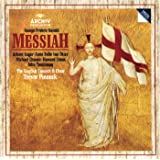
Switching gears to Easter now, for the Christians among the readers you may have a particular work that you like to listen to. Maybe you’ve heard of Handel’s Messiah? It’s not just for Christmas you know. In fact, it was originally written for Easter and debuted a couple of weeks after Easter in 1742. If you’re not familiar with the text, it loosely tells the story of Christ from before birth to death and then Resurrection. Therefore, fitting for Christmas and Easter. My favorite recording of the Messiah is by the English Consort and Chorus conducted by Trevor Pinnock. I’m not the only one who likes it; it is often regarded as the best recording. It’s on Spotify and You Tube, and other streaming services.
Another very common work for Easter is the St. Matthew Passion by J.S. Bach. Full transparency; the first time I heard this live I, and many around me, slept through large parts of it. A gentleman in front of us hit his head hard enough against the wooden seat back that many could hear it. I was young, I suspect the Calgary Philharmonic Orchestra was not anything like it’s current iteration, and while it has “Passion” in the title, Bach had a different way of expressing passion (not bad, just different) from more romantic composers (many don’t share my view by the way, it is considered one of the greatest works in the Western repertoire). In any case, the story is pretty dramatic and as a more “mature” listener I do have a greater appreciation for it than when I was 17. I can’t tell you a favorite recording, but there are many. You can’t really go wrong with this one, or this one. If you’d like a guided version, NPR has one here.
Another very common text setting is the Stabat Mater (Sorrowful Mother) and is about Mary’s suffering during Christ’s Crucifixion. Many, many composers have put this 13th century sequence to music, possibly the most famous of those is Giovanni Battista Pergolesi. Pergolesi wrote it in the final weeks of his life and, it is said, finished it just before he died. Here is Pergolesi’s version and, if you’d like to compare, one from Dvorak, and one from Part.
Lastly is one that is new to me (but could qualify as both Easter and Passover… if you really stretch), The Passion of Yeshua by Richard Danielpour. This one I discovered through a service called Idagio (more about that in another post). The lyrics depict the final 12 hours of the life of Jesus and it’s written in both Hebrew and English.
I wanted to write a passion oratorio that would bring the story of the last 12 hours of the life of Jesus of Nazareth back to its Jewish origins because I wanted to give Christians in America the opportunity to more fully understand how deeply the root of their Christian faith is steeped in Judaism. I was also hoping to allow for the possibility of Jewish people in America to see the person of Jesus without the presence of all of the European accretions, and outrageous acts that were committed in the name of European Christianity over the last 2000 years.
Richard Danielpour
It’s a great idea and a very interesting work. You can listen to it here and here.
Anything you think is a must listen for either Passover or Easter? Let me know.
 I Have Things to Say About Music
My listening list for this wkd. Thanks, I will enjoy it, of that I have no doubt.🎶💕
LikeLike
This is so cool
*From:* I Have Things to Say About Music *Sent:* April 7, 2020 11:30 PM *To:* julie@parentingpower.ca *Subject:* [New post] Spring Holy Holidays
Kenton posted: ” Music for Passover & Easter Well, here we are, it’s Passover and Easter, although most of us have bigger things on our mind. However, music can be a great source of calm and/or spiritual connection. This holiday period is a perfect time to find so”
LikeLike